Summary
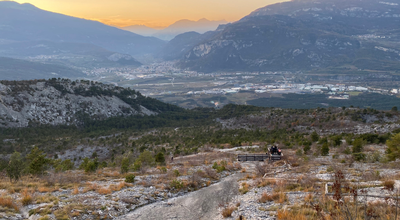
The nature reserve can be visited along a flat circular trail (about 1.5 hours of easy walking). It includes two small wetlands, the “Laghet grant” and the “Laghet picol”, which occupy two sinkholes located among landslide deposits.
The main points of naturalistic interest are geomorphological (a post-glacial landslide) and its role as a breeding site for various amphibian species.
In the immediate vicinity, on the adjacent mountain slope, there are hundreds of dinosaur footprints, often arranged in actual trackways.
The Reserve is also part of the Natura 2000 network (Special Area of Conservation, under the name “Laghetti di Marco”).
Description
The water level of the two ponds is variable, as their bottom—made up of landslide debris—is porous and permeable.
The vegetation surrounding the ponds is made up of species typical of wet environments such as cattail (Typha latifolia) and common reed (Phragmites australis). Alongside these are species that are rare in Trentino, such as Carex gracilis and Teucrium scordium, as well as Bidens frondosa, which was recorded here for the first time in Trentino.
The ponds are also of great importance from a faunal perspective. Among invertebrates, there are very interesting species such as hydradephagous beetles, aquatic beetles that live in environments with good ecological conditions (51 of the 200 species present in Italy have been recorded here).
Among the amphibians that frequent the ponds are newts (Triturus spp.) and the common toad (Bufo bufo); among reptiles, the most common is the grass snake (Natrix natrix).
In spring it is not uncommon to observe the common moorhen (Gallinula chloropus), which nests here, or to hear its unmistakable alarm call.
Within the biotope there is a black pine forest (Pinus nigra), a species introduced here in the 1930s in an attempt to reforest this area, which was originally almost entirely devoid of tree cover.
In the sunniest areas there are plant species typical of dry environments and calcareous substrates, such as the beautiful alpine daphne (Daphne alpina), which is very rare at such low altitudes. This habitat also shows great naturalistic interest and hosts various species of reptiles, birds, and mammals.